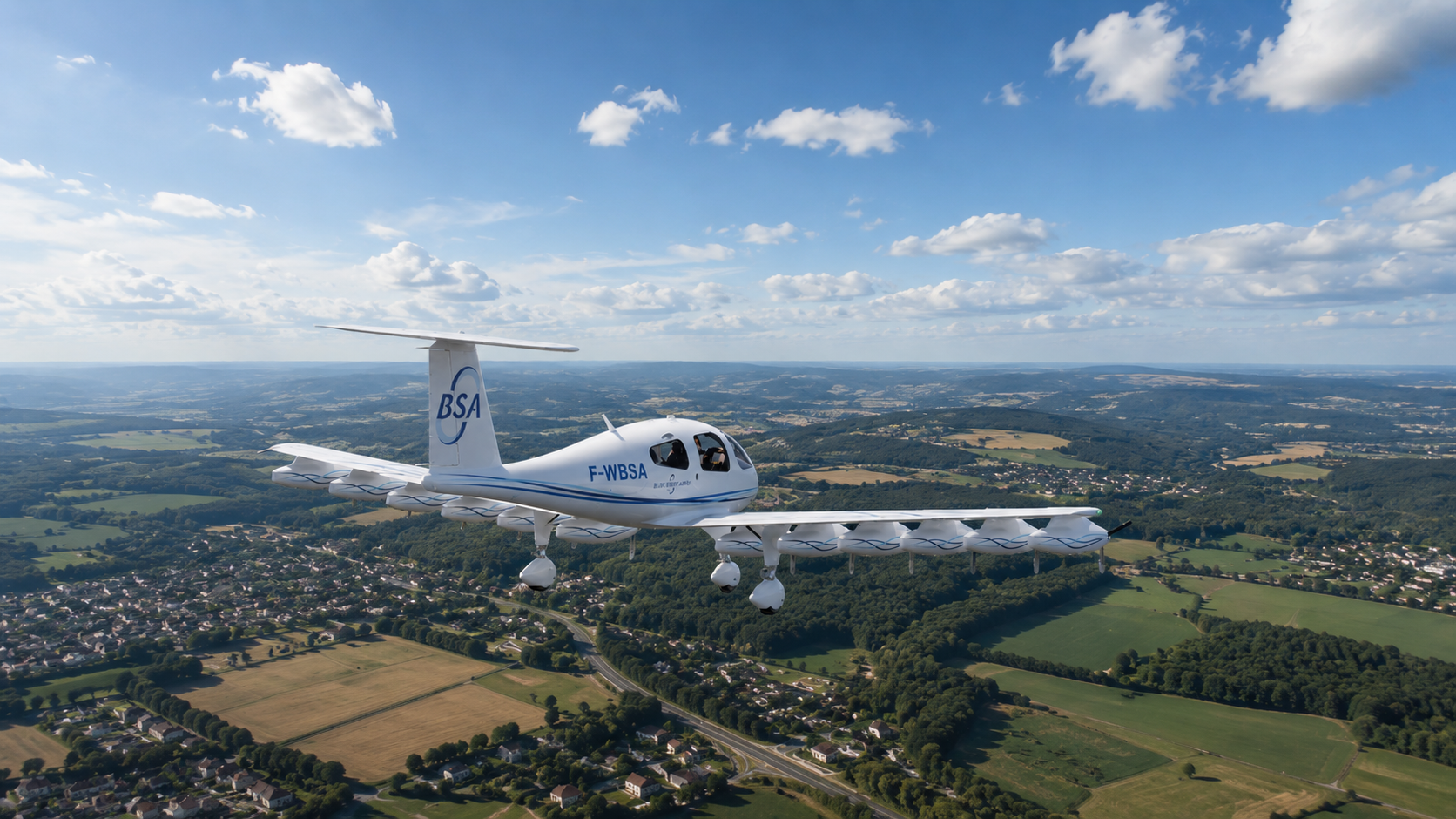
Blue Spirit Aero=H2Hydrogen+ Distributed Electric Propulsion
Hydrogen
It begins with the most abundant element in the universe. The Dragonfly draws its energy from gaseous hydrogen, stored under pressure in onboard tanks — a clean fuel whose only by-product is water.
Fuel cell + Motor
Inside the fuel cell, hydrogen becomes electricity — silently, and without combustion. That current feeds an electric motor, turning a single propeller with the smoothness only electric flight can offer.
Integration
Tank, fuel cell and motor are then condensed into one aerodynamically optimised pod — a self-contained propulsion unit, engineered to slip through the air.
12 Motors
Multiply that pod by twelve. The Dragonfly is powered by 12 identical motors, spread along the wing — distributed electric propulsion in its purest form.
Wing Blowing
Spread across the full span, the twelve pods blow a stream of accelerated air over the wing's upper surface. This active blowing boosts lift far beyond a conventional wing — shorter take-offs, lower approach speeds, and a wider safety margin.
Independent Motors
In flight, each of the twelve motors runs fully independently. This built-in redundancy all but eliminates critical failure — there is no longer a single engine to lose, and emergency landings become a scenario of the past.
Failure, Isolated
So what happens if a motor fails? Because they share no common driveline, the faulty pod is instantly isolated — shut out in a fraction of a second while the eleven others keep turning. There is no critical loss to manage: the Dragonfly flies on undisturbed, its thrust simply rebalanced across the wing.
Maintenance
Each pod is an identical, interchangeable module. Rather than grounding the whole aircraft, the affected unit is swapped out in a few steps — maintenance that is simpler, faster and cheaper, designed in from the start.
Cockpit
Yet from the cockpit, all of this disappears. The twelve motors are managed transparently, so the pilot flies the Dragonfly as a simple single-engine aircraft. A multi-engine configuration can even be unlocked for training — making one airframe versatile, safe, and clean at once.
Frequently Asked Questions